Global web icon
geeksforgeeks.org
https://www.geeksforgeeks.org/maths/domain-and-ran…
Domain and Range of a Function - GeeksforGeeks
A function represents a relationship between a set of inputs (domain) and their corresponding outputs (range), where each input has exactly one output. Domain: The set of all possible input values for which the function is defined.
Global web icon
cuemath.com
https://www.cuemath.com/calculus/domain-and-range-…
How to Find Domain and Range of a Function? - Cuemath
Domain refers to input values and range refers to output values generated by the function. Learn how to find the domain and range of a function along with many examples and graphs.
Global web icon
wikihow.com
https://www.wikihow.com/Find-the-Domain-and-Range-…
How to Find the Domain and Range of a Function - wikiHow
The domain of a function is the collection of independent variables of x, and the range is the collection of dependent variables of y. To find the domain of a function, just plug the x-values into the quadratic formula to get the y-output.
Global web icon
ck12.org
https://www.ck12.org/flexi/algebra/domain-and-rang…
How to write domain and range? - CK-12 Foundation
Write the domain in interval notation or set notation. Range: The range is the set of all possible output values (usually @$\begin {align*}y\end {align*}@$) that the function can produce.
Global web icon
libretexts.org
https://math.libretexts.org/Bookshelves/Algebra/Co…
3.3: Domain and Range - Mathematics LibreTexts
In creating various functions using the data, we can identify different independent and dependent variables, and we can analyze the data and the functions to determine the domain and range. In this section, we will investigate methods for determining the domain and range of functions such as these.
Global web icon
lumenlearning.com
https://courses.lumenlearning.com/waymakercollegea…
Write Domain and Range Given an Equation | College Algebra
In Functions and Function Notation, we were introduced to the concepts of domain and range. In this section we will practice determining domains and ranges for specific functions.
Global web icon
analyzemath.com
https://www.analyzemath.com/DomainRange/DomainRang…
Domain and Range of a Function
A step by step tutorial, with detailed solutions, on how to find the domain and range of real valued functions is presented. First the definitions of these two concepts are presented.
Global web icon
onlinemathlearning.com
https://www.onlinemathlearning.com/domain-range.ht…
Domain and Range of Functions (video lessons, examples, solutions)
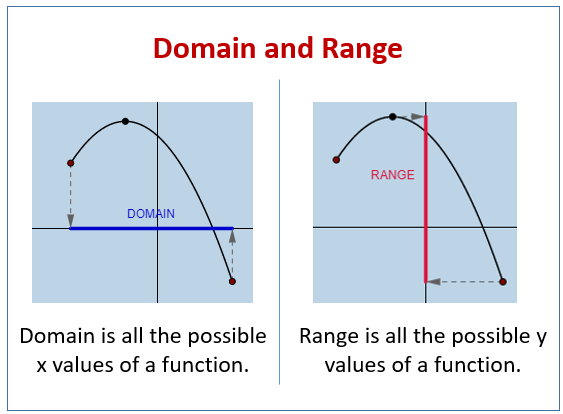
Domain and Range of a Function. The domain of a function is the set of all possible input values (x-values) for which the function is defined. The range of a function is the set of all possible output values (y-values) the function can produce. The following diagrams show the domain and range of a function.
Global web icon
intmath.com
https://www.intmath.com/functions-and-graphs/2a-do…
Domain and Range of a Function - Interactive Mathematics
In general, we determine the domain of each function by looking for those values of the independent variable (usually x) which we are allowed to use. (Usually we have to avoid 0 on the bottom of a fraction, or negative values under the square root sign).
Global web icon
math.net
https://www.math.net/domain-and-range
Domain and range - Math.net
In other words, the domain is the set of values that we can plug into a function that will result in a real y-value; the range is the set of values that the function takes on as a result of plugging in an x value within the domain of the function.